
Ada County CTC Overview
The Ada County Community Transition Center, often shortened to CTC in the research, is operated by the Ada County Sheriff's Office as part of the county jail system. It is not an Idaho Department of Correction prison and not a separate public locator system. ACSO describes it as the place where some inmates go to prepare for release back into the community. The population is selected, sentenced jail inmates who are near release and may take part in work search, employment, and classes.
The CTC has 100 beds, with 68 for men and 32 for women. ACSO's 2023 annual report says the CTC average daily population was 54 and that CTC average daily population had tripled since the CTC was established in 2020. A person must be ordered to the Community Transition Program and have at least 30 days to serve at the CTC. The CTC is tied to the Barrister Drive sheriff and jail campus rather than a separate statewide prison address.
ACSO's programs source shows jail and CTC program details on the Ada County Jail programs page.
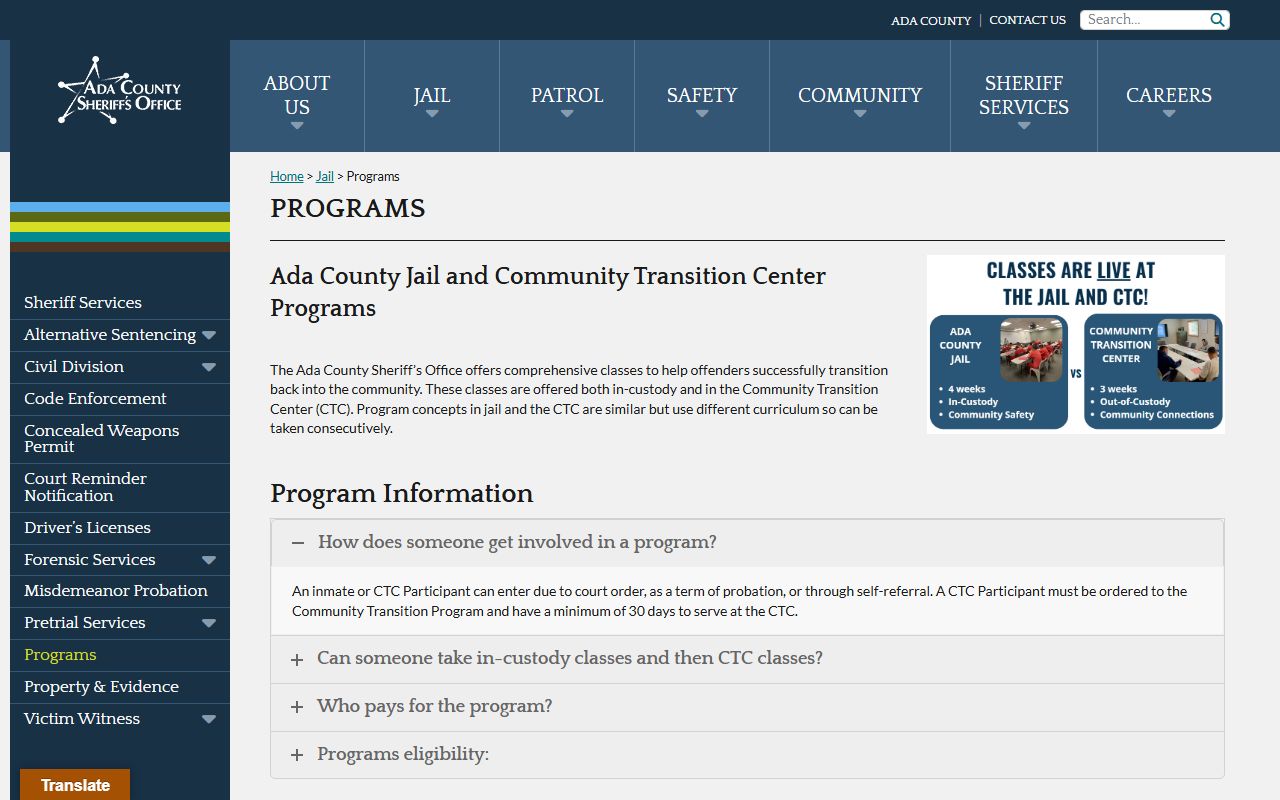
The programs image is the best manifest match for the Ada County Community Transition Center because it includes CTC class rules, eligibility, costs, and work-readiness details.
Ada County CTC Population
Ada County Community Transition Center capacity and population figures are narrower than the main jail's numbers. The CTC capacity is 100 beds, divided between 68 male beds and 32 female beds. The 2023 ACSO annual report listed a CTC average daily population of 54. Those numbers should not be merged with the main Ada County Jail daily average population unless the source is clearly describing the total jail system. The CTC is a work-release and transition setting inside county jail custody, so its count is a program and facility count, not a state-prison population count.
CTC custody is selective. ACSO says program entry can occur by court order, as a term of probation, or by self-referral for some programs, but CTC placement itself requires an order to the Community Transition Program. The person also needs enough time left to complete the class or transition plan. That makes the CTC different from a public jail booking unit, where an arrested person may arrive before classification, bond, or a first appearance.
Ada County CTC Roster Search
No separate Ada County Community Transition Center locator was located in the research. Use the Ada County Inmate Roster for current adult jail custody and the Ada County Current Arrests report for recent bookings. The roster search is a last-name-prefix search, updated every 24 hours, and ACSO says inmate status can only be confirmed in person or by phone at 208-577-3000.
- Search the Ada County Inmate Roster by the first letter or letters of the last name.
- Review visible name, JID, age, arresting agency, charge type, bail, and any VINE link.
- Do not expect the public roster to show a CTC bed, dorm, pod, or program assignment.
- Call ACSO at 208-577-3000 for status confirmation or the Programs Office at 208-577-3400 for program routing.
- If the person has been sentenced to state custody, switch to the IDOC Resident/Client Search rather than the Ada roster.
The roster source is the official Ada County Inmate Roster search page.
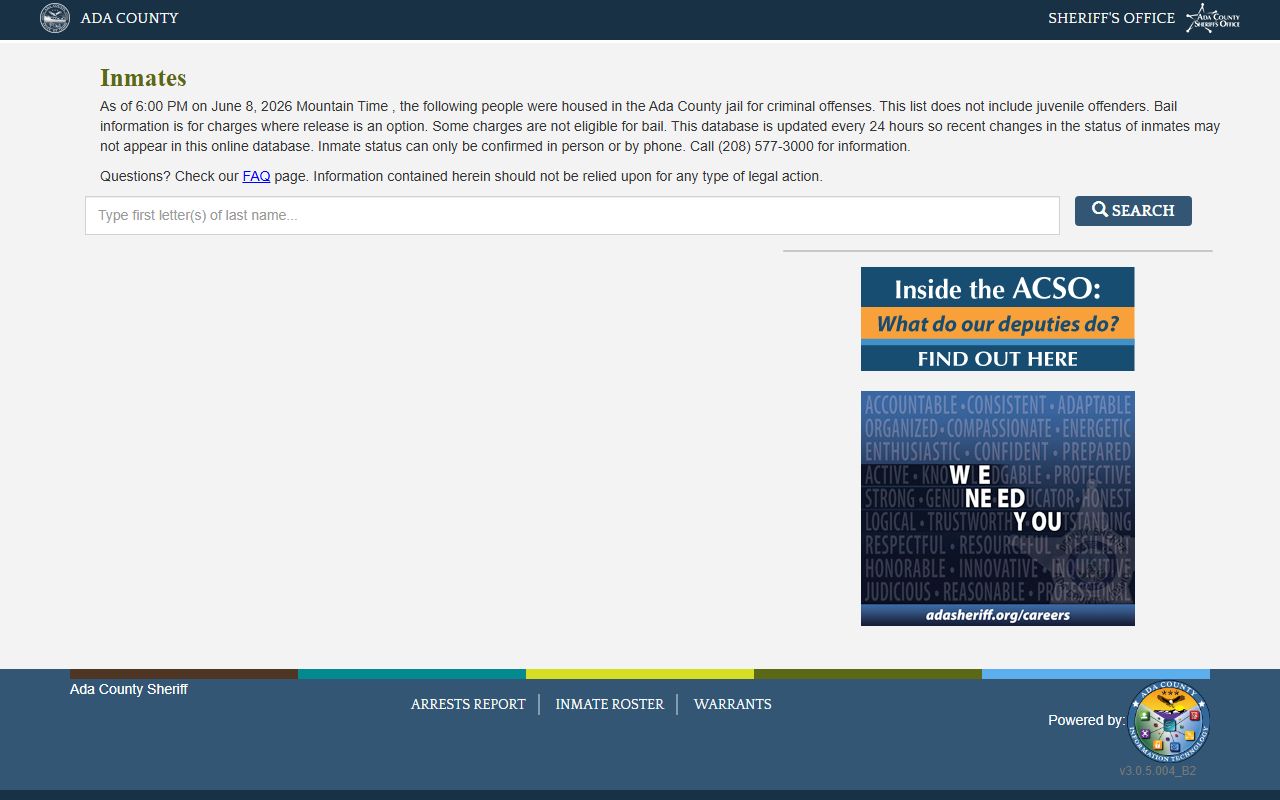
The roster image shows the practical limit for a CTC lookup: the public tool searches Ada County jail custody, but it does not publish a dedicated CTC-only search field.
Ada County CTC Contact
The Community Transition Center is tied to the Ada County Sheriff's Office and jail campus on Barrister Drive. The main ACSO phone line is the fallback for custody status, while the Programs Office is the more specific contact for program information. ACSO lists the Programs Office at 7200 Barrister Drive, Boise, with weekday business hours and holiday closure. For records requests, use the ACSO public records process rather than sending a request to a state prison or court office.
Ada County Community Transition Center
Ada County Sheriff's Office/Jail campus
Barrister Drive, Boise, ID 83704
208-577-3000
Use ACSO for custody status confirmation.
ACSO Programs Office
7200 Barrister Drive
Boise, ID 83704
208-577-3400
Monday-Friday, 7 a.m. to 3 p.m.; closed holidays.
Public information requests for booking records, Ada County arrest history, or older custody records can be routed through the ACSO records request page. ACSO says requesters should be specific and include complete names and dates of birth for records about an individual.
Ada County CTC Programs
ACSO programs are offered in both jail and the Community Transition Center. The concepts can overlap, but ACSO says the jail and CTC use different curriculum, so classes can be taken consecutively. CTC participants may do work search, apply for jobs, take classes, and go to work if employed. A participant must meet eligibility requirements, including classification level, discipline-free time, housing status, adequate time left to finish the class, and funding before starting.
| CTC Program | Schedule and Cost | Purpose |
|---|---|---|
| Active Behavioral Change | Three days per week, two hours per day, three weeks; $150 at CTC. | Cognitive-behavioral and behavior-change work. |
| Substance Abuse Program | Three days per week, two hours per day, three weeks; $150 at CTC. | Alcohol and drug use work using journaling and relapse prevention. |
| Workforce Readiness | Two days per week, two hours per day, three weeks; no cost. | Job applications, resumes, interviews, and job-retention skills. |
Classes are paid for by the participant unless a court provides financial help or a scholarship is approved. Workforce Readiness is the exception listed with no cost. The CTC's program role should not be confused with Idaho Department of Correction reentry centers in Ada County, which hold sentenced IDOC residents and use IDOC lookup, visit, mail, and money rules.
Ada County CTC Visits
The research did not locate a separate public visitation system for the Ada County Community Transition Center. Because the CTC is jail custody under ACSO, public visit routing should start with Ada County Jail public video visitation and ACSO confirmation. ACSO says public visits between inmates and the public are completed online through GettingOut. Each inmate receives two free 25-minute online visits per week. Professional visits use VVS for approved attorneys, clergy, court-ordered evaluators, Health and Welfare evaluators, presentence investigators, and other approved professionals.
| Visit Type | Scheduling | CTC Use |
|---|---|---|
| Public social visit | GettingOut through Ada County Jail video visitation | Confirm availability for the CTC participant before scheduling. |
| Attorney or approved professional | VVS authorized-user system | Only approved professionals may use VVS. |
| Program or employment release movement | ACSO Programs Office | Not a public visit. Ask ACSO about program-specific rules. |
The professional visit source is the Ada County attorney and professional visitation page.
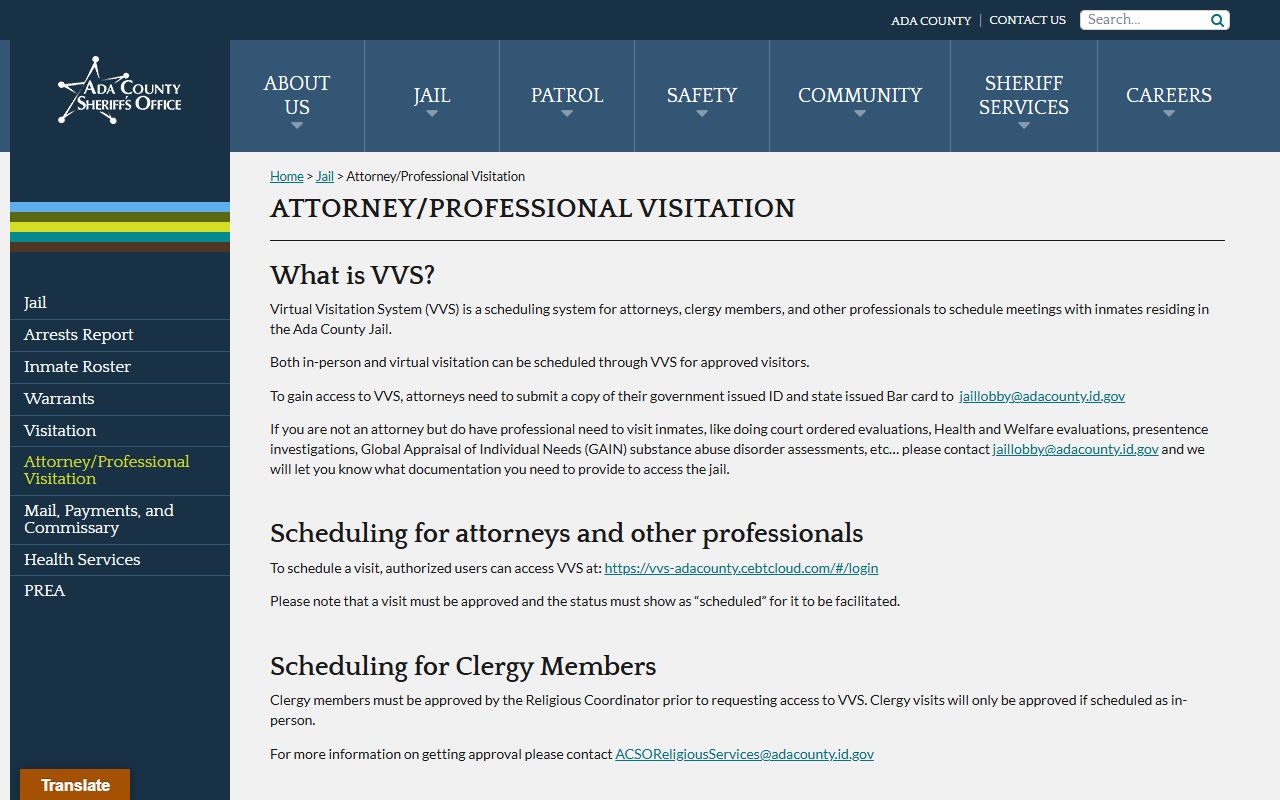
The professional visitation image helps separate public video visits from approved professional scheduling, which matters for CTC participants with court or program contacts.
Ada County CTC Mail and Money
The research did not identify CTC-only mail or money rules. Use the Ada County Jail mail and payment rules unless ACSO gives a different instruction for a specific participant. Personal mail to inmates is scanned through the Phoenix, Maryland processing address and sent electronically. Mail must include the sender's and receiver's full name and address. Inmates cannot receive incoming phone calls, but most inmates may buy outgoing phone time.
| Service | Provider / Detail |
|---|---|
| Scanned mail | Ada County Jail, ID, inmate full name, JID number, PO Box 247, Phoenix, MD 21131. |
| Publications | Publisher or bookstore only, excluding Amazon, with name and JID sent to 7210 Barrister Drive. |
| Money deposit | ACSO kiosk or online Telemate/GettingOut deposit. |
| Phone support | GettingOut/Telemate support at 1-866-516-0115. |
ACSO says inmates must keep a $15 balance in the personal account and may use funds above that for commissary items. If an inmate has no money in the commissary account for seven days before a commissary request, the jail supplies necessary hygiene items as determined by staff plus three stamped envelopes and writing paper each week.
Ada County CTC Custody Flow
CTC placement usually comes after jail booking, classification, court action, and a local sentence or program order. It is not the first intake point for a new arrest. A person arrested in Ada County may appear in Current Arrests, then on the Ada County Inmate Roster if housed in the jail. If that person becomes eligible and ordered to the Community Transition Program, the CTC can become part of the end-of-sentence custody path. If the person is sentenced to prison instead, the lookup moves to IDOC Resident/Client Search.
Flow: arrest or sentence in Ada County jail custody, classification, court or program order, CTC placement if eligible, work search or employment, classes, and release preparation. This flow can change because holds, warrants, discipline, health needs, court orders, or new charges may alter custody status.
Note: Confirm CTC placement and visit rules with ACSO before relying on a roster result or making travel plans.
Ada County CTC Records
CTC custody records are still Ada County jail records for lookup purposes. The public roster may show the person, charges, JID, age, arresting agency, bail values, type, and VINE link, but it does not show detailed program status or CTC assignment in the fields inspected. Idaho public records rules allow requests for sheriff's records, subject to law-enforcement restrictions, victim and witness redactions, fair-trial concerns, and juvenile exclusions. ACSO also says some records about ongoing investigations or investigative techniques may be withheld.
The difference between county CTC custody and state reentry custody is important in Ada County. Treasure Valley Community Reentry Center and East Boise Community Reentry Center are IDOC facilities, not ACSO's CTC. They hold minimum-custody IDOC residents and use the IDOC Resident/Client Search. The Ada County Community Transition Center uses the Ada jail roster, ACSO phone confirmation, and ACSO program channels.